He says, “I already apologized.” You heard the apology. What you still do not know is what happens to the problem he left behind.
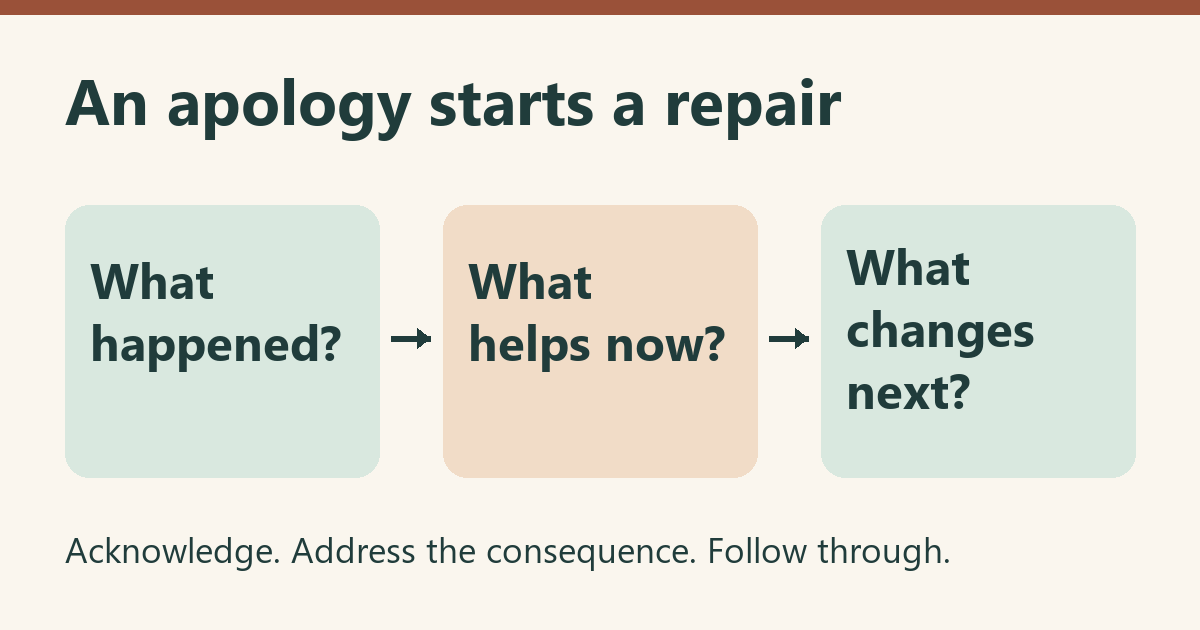
When your partner breaks an agreement, it can help to separate three questions: What happened? What can be repaired now? What will change next time? That gives you something more concrete to discuss than whether you should be over it yet.
You do not need a flawless apology or a dramatic gesture. You need room to name the impact and see whether he is willing to take responsibility for an appropriate next step.
First, name the agreement you both understood
Consider this fictional example. You and your partner agreed to check with each other before giving away things from a shared cupboard. While clearing it out, he gives away a serving dish that mattered to you. He thought it was unused; you thought the agreement protected it.
The starting point is specific: “We agreed to check before giving things away. You gave away the dish without checking, and I cannot simply undo that.”
This is different from trying to prove that he never considers you. Keeping the conversation attached to one event makes the request clear without minimizing it.
If you discover that you understood the agreement differently, clarify the difference. An expectation you never discussed needs a conversation too, but it is not automatically a promise he knowingly broke. Ask what each of you believed you had agreed to before arguing about motives.
Let the impact be part of the conversation
He may explain that he was trying to help. You can recognize that intention while still explaining the effect: “I understand you wanted the cupboard cleared. I was upset because you made a decision about something important to me after we had agreed to decide together.”
You do not have to claim he intended to hurt you. You also do not have to reduce the problem to a misunderstanding if the agreement was clear.
Try naming the actual consequence: something is missing, a choice was taken away, or you now feel uncertain about whether a shared decision will be respected. Avoid adding several older arguments just to make this one count. One broken agreement can deserve attention on its own.
Ask what repair would look like now
An apology can matter, and the practical consequence may still need attention. Ohio State’s report of a 2016 study highlights accepting responsibility and offering repair as strong elements in participants’ ratings of apologies. The experiments used a hypothetical professional scenario; they did not test whether a particular conversation repairs a romantic relationship. Read the university’s report on effective apologies.
In the cupboard example, repair might begin with him asking whether the dish can be returned. If it cannot, he can acknowledge that buying another one may not replace what mattered about it. You can discuss a reasonable practical response without pretending that every consequence can be erased.
A useful question is: “What can you do to address what happened, beyond saying you are sorry?”
He should have room to suggest a response. You can explain what would help without becoming responsible for inventing, assigning and supervising his entire apology.
Repair should be proportionate to the situation. It is not an invitation to punish, demand access to private devices, or require endless proof of loyalty.
Choose a change that belongs to the person making it
“I’ll be more thoughtful” sounds reassuring but leaves the next decision unclear. A concrete change in this example would be: “I will leave anything that belongs to you in place until we have decided together.”
The person making that commitment needs to choose a workable way to remember it. Your repeated reminders should not become the condition that makes his agreement valid.
You can use this short conversation starter:
“I appreciate the apology. I still need us to address what happened to the dish and agree on how decisions about our belongings will work. What can you do about the loss now, and what will you do differently when you next clear the cupboard?”
Use your own words and only the parts that fit. This is an original practical exercise, not a formula that guarantees a particular response.
Notice what follows without becoming an inspector
Trust does not have to return at the speed of his apology. You can appreciate an effort and still need time to see whether the agreement is respected.
Look at ordinary behavior: Does he take the repair step he offered? Does he respect the next shared decision? If something goes wrong again, does he bring it up and address it, or leave you to discover and explain it?
You do not need to set traps, check private messages or keep a secret score. The purpose is to decide what you can reasonably rely on.
If apologies keep arriving without a practical change, name that pattern: “We’ve talked about this, but the agreement is still being broken. I need to reconsider what decisions and belongings I can safely share in this arrangement.” Choose a response you can carry out; do not make a threat to force an apology.
Know when this conversation is not the right tool
This approach assumes you can disagree without fear. If raising a concern brings intimidation, retaliation or pressure to give up your boundaries, prioritize your safety and seek confidential support instead of trying to perfect the request. Love is respect explains why safety concerns change how to respond to a crossed boundary.
For an ordinary disagreement, begin with the smallest unresolved piece: the agreement, its consequence, or the next action. You can accept that an apology was offered without agreeing that the repair is finished.
Response
[…] one person proposed. If you both agreed on a check-in and it was missed, this guide explains how to ask for repair after a broken agreement. Keep the discussion about the specific agreement and its effect rather than trying to prove what […]