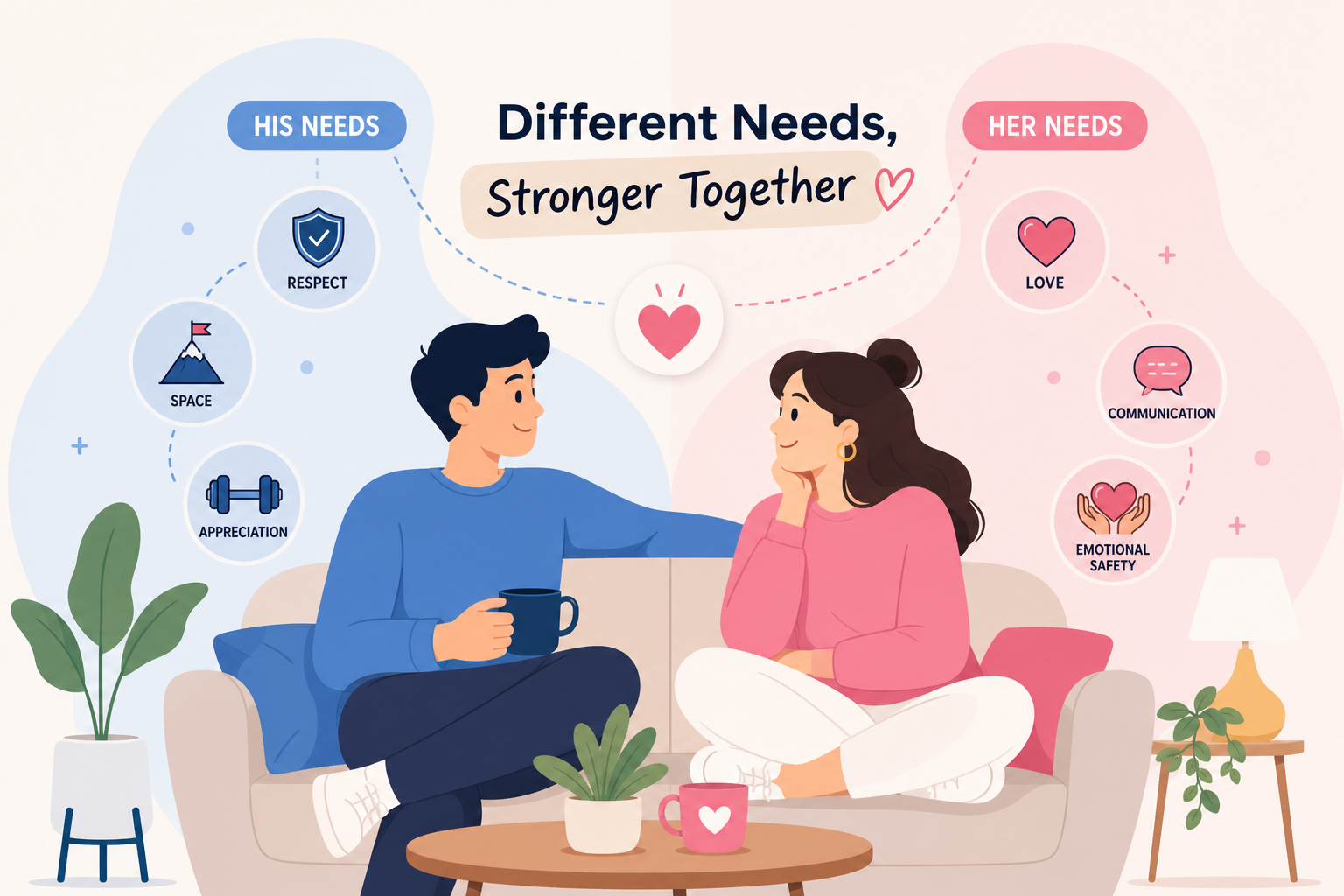
Men’s needs vs women’s needs in relationships often look different even when both partners are genuinely trying. You can see the effort on both sides. He shows up, you show up, and yet something invisible keeps you from feeling truly close. The effort is there, but the connection isn’t landing. That quiet disconnect, where love is present but understanding is missing, is one of the most disorienting places a woman can find herself in a committed relationship.
Here’s what’s actually happening in most cases: men and women don’t want opposite things. They want the same core things, safety, love, belonging, but they often need different expressions of those things. When neither person knows how to read the other’s emotional language, the gap between them grows quietly and steadily, even when no one is doing anything wrong.
This article walks through seven common gender-patterned needs, explains why they diverge, and gives you three concrete strategies you can use starting tonight. No blame, no scorekeeping. Just clarity on what’s actually going on beneath the surface, and a clearer map for getting through to each other.
What women most commonly bring to the emotional table
Before turning the lens toward him, it helps to name your own experience first. Psychological safety works this way: you can absorb new perspectives more openly once your own reality has been acknowledged. So let’s start there.
Emotional intimacy and feeling deeply understood
Research published in Frontiers in Psychology found that women’s well-being in relationships is strongly linked to what researchers call “emotional accessibility”, the experience of a partner being genuinely present, emotionally available, and attuned to your inner world. For most women, talking through feelings is not just a means to an end. It is itself the form of connection. The conversation is the intimacy, not a prelude to it.
This is why silence can feel like rejection, even when it isn’t. When a woman processes something out loud and her partner goes quiet or jumps to solutions, she often reads that as emotional absence. She’s not wrong to feel it. She’s just missing some context about why it’s happening, which we’ll get to shortly.
Validation, prioritization, and the need to feel chosen
The second cluster of needs includes validation (feeling her perspective is taken seriously), prioritization (knowing she matters more than the phone, the work, the silence), and relationship stability. Studies drawing on Gottman’s research on relationship satisfaction consistently identify these as significant predictors of women’s psychological well-being in partnerships. These aren’t signs of neediness. They are the emotional conditions under which most women feel safe enough to be fully present and open in a relationship.
When these needs go unmet for long enough, women often don’t get louder. They get quieter in a different way: more guarded, less hopeful, more exhausted by the effort of trying to reach someone who doesn’t seem to notice the distance.
Men’s needs vs women’s needs: what men need emotionally and why they rarely name it
This is the section most women come looking for, and it’s worth slowing down here. Understanding the male emotional world doesn’t require excusing disconnection or lowering your standards. It requires learning a different emotional language, one that most men were never taught to speak out loud.
Some commentators have explored why men may experience relational urgency differently than women; for a readable discussion of these patterns, see this Psychology Today explanation.
Respect, appreciation, and not feeling chronically judged
Gottman’s demand-withdrawal research and broader relationship counseling literature identify respect and appreciation as core emotional needs for men in partnerships. When a man feels criticized frequently, dismissed, or subtly corrected, his emotional safety erodes in the same way a woman’s does when she feels unheard. He just doesn’t typically name it that way. The parallel is almost exact: feeling respected is to him what feeling understood is to you.
This doesn’t mean he needs agreement on everything. Respect, in this context, means being listened to without contempt, having his effort acknowledged, and feeling trusted to handle things competently. When those conditions are absent, many men disengage, not out of indifference, but out of self-protection. The withdrawal that looks like coldness is often insecurity wearing a stoic mask.
Physical connection, space to process, and feeling trusted
Research in attachment and sexuality confirms that for many men, physical intimacy functions as an attachment behavior, not only a physical one. Sex often communicates “I want you, I trust you, we’re okay” in a way that words don’t always reach. When physical closeness disappears from a relationship, many men experience it as emotional rejection, even if that was never the intention.
Then there’s the processing-space need, which is genuinely confusing for women who process by talking. Many men need time alone before they can engage emotionally. This isn’t stonewalling; it’s regulation. They often return more available after space than they would be if pushed to talk immediately.
Men’s needs vs women’s needs: 7 differences that explain the disconnect
These aren’t opposites. They’re the same human needs expressed through different emotional frameworks. Reading them as pairs helps you see where the crossed signals actually originate, and how men’s needs vs women’s needs in relationships play out in everyday moments.
Needs 1 through 4: where the wires most often cross
Validation vs. respect. She needs to feel understood; he needs to feel appreciated and not constantly corrected. Both are asking for emotional acceptance. The delivery system is just different. When she pursues understanding and he perceives criticism, or when he pulls back and she perceives indifference, both are reacting to the same threat: feeling emotionally unsafe with their person.
Talking as connection vs. silence as processing. She connects through discussing feelings. He often resolves things internally first, then re-engages. Neither approach is broken. They’re just not synchronized, and without awareness, they read as abandonment on one side and suffocation on the other.
Verbal empathy vs. practical support. She often needs to feel heard before solutions land. He often expresses care by fixing, which can feel dismissive even when it comes from a genuine desire to help. His “have you tried…” is not a dismissal of her feelings. It’s his version of “I want this better for you.” Understanding that reframes a lot of arguments.
Consider a common scenario: she comes home stressed and starts talking through her day. He immediately suggests three ways to fix the problem. She feels unheard; he feels unappreciated for trying to help. Neither person is wrong. They’re just speaking from different emotional blueprints.
Feeling prioritized vs. feeling trusted. She needs to know she matters most in his world. He needs to know she believes in him, that she’s not constantly waiting for him to fail. Both are asking the same underlying question: “Am I enough for you?”
Needs 5 through 7: the subtler gaps
Words as security vs. actions as security. She often feels loved through verbal affirmation and reassurance. He often feels loved through consistent presence and low-conflict companionship. He may interpret her need for “I love you” as a sign she doesn’t trust him, when she’s simply wired to feel that love most clearly when it’s spoken.
Emotional closeness through conversation vs. through shared experience. She builds intimacy by talking. He builds intimacy by doing things together, watching a show, fixing something side by side, sharing a meal without an agenda. Both are genuinely seeking closeness. The method looks so different that they often miss each other entirely.
Commitment shown emotionally vs. shown through consistency. She wants to hear it. He expresses it by showing up reliably, day after day. When she asks “but do you really want this?” after years of consistent effort on his part, he may genuinely not understand why the question is still open.
These are patterns, not rules. Individual attachment history and life stage shape how any of these actually show up in a specific relationship. For more posts that explore these dynamics in other ways, see our Blog.
Why attachment style changes the whole equation
Gender patterns in relationships are real, but they’re modified significantly by how each person was shaped by early experiences of closeness and safety. Attachment style often predicts relationship behavior more accurately than gender alone.
When the anxious partner chases and the avoidant one retreats
The anxious-avoidant dynamic is one of the most frequent sources of relationship distress in adult partnerships. An anxiously attached person, regardless of gender, pursues closeness when they feel threatened. An avoidantly attached person, regardless of gender, creates distance when they feel overwhelmed. For empirical overviews of attachment-related patterns and relationship outcomes, see this review on attachment dynamics.
An anxiously attached man may need more reassurance than many women. An avoidantly attached woman may need more space than most men expect. The gender script breaks down completely when attachment style runs in a different direction. The underlying need, in both cases, is emotional safety. The expression just depends on whether closeness or independence feels safer to that particular person.
How age and personal history reshape what each person actually needs
Needs shift with life stage in predictable ways. Younger adults often prioritize intensity, chemistry, and excitement. Midlife adults, particularly those in the 35 to 55 range, tend to prioritize emotional reliability, low conflict, and genuine companionship. People who have been through painful relationships often name their needs more precisely, not because they’re more demanding, but because they know the cost of going without.
If you’re 40 or 48 and feel like the standard gender frameworks only partially explain your experience, that’s accurate. Your history and your nervous system have shaped what you need in ways that no single framework can fully capture. What remains consistent across all of it is this: both people want to feel safe, valued, and genuinely known by the person they chose.
Three strategies to close the gap starting tonight
This is where understanding becomes action. These three approaches draw on well-established communication principles, open-ended questioning, needs-based expression, and active listening, and are specific enough to use in a real conversation tonight, not someday after everything is fixed.
Lead with curiosity before reacting
When he goes quiet, or offers a solution when you needed empathy, the instinctive response is often to read it as rejection or dismissal. The curiosity-first approach interrupts that loop before it escalates. Try: “Can you help me understand what’s going on for you right now?” That single question signals emotional safety, and emotional safety is the one condition under which most men open up. It shifts the interaction from two people defending their positions to two people genuinely trying to reach each other.
Name what you need, not just what’s wrong
Vague complaints leave him uncertain how to respond, which often leads to silence or defensiveness. Specific needs give him something he can actually do, and doing is often how men feel most useful in a relationship. Try: “I’ve been feeling disconnected lately, and I’d really love 20 minutes of just us tonight, no phones, no agenda.” That’s a feeling, a need, and a concrete request all in one sentence. Specificity is a form of respect. It honors his genuine desire to help by making it possible for him to succeed.
Learn to read his emotional language before translating it through yours
Many behaviors that feel like withdrawal are actually his version of emotional regulation: going quiet after conflict, offering fixes instead of comfort, initiating physical touch when words feel hard. Recognizing his language doesn’t mean excusing disconnection. It means responding to what is actually happening, rather than what it looks like through your emotional framework.
Three signals worth watching: whether he re-engages after time alone (that’s regulation, not rejection), whether he shows up consistently in action (that’s his version of commitment), and whether he reaches for you physically when conversation has stalled (that’s often his way of saying “we’re still okay”). Try applying one of these tonight and notice what shifts.
Where this all leads
Men’s needs and women’s needs in relationships are not in competition. They are two versions of the same desire: to feel safe, loved, and truly known by the person who matters most. The seven patterns covered here are not flaws in either partner. They are the result of different emotional languages shaped by socialization, personal history, and the attachment patterns formed long before this relationship began.
The path forward isn’t about changing who you are. It’s about learning enough of your partner’s language to stop accidentally sending the wrong signal. The three strategies in this article are starting points. They work because they address the actual mechanism of disconnection: the moment when two people who love each other read each other’s behavior as threat instead of need.
If you want to go further in understanding the male side of this equation, without guesswork or generic advice, UnderstandingMan.com offers non-judgmental, practical insight built specifically for women who want to move from confusion to genuine connection. Understanding is where closeness begins, and that understanding starts with you. Read our focused piece “Understanding Men’s Needs in a Relationship: What He Can’t Say” for a deeper look, and see our About Page and Policy for site information and approach.
Leave a Reply