Your partner looks at a phone while you are halfway through telling a story. You stop, restart, and wonder whether to keep talking. It is reasonable to want attention during a conversation that matters to you.
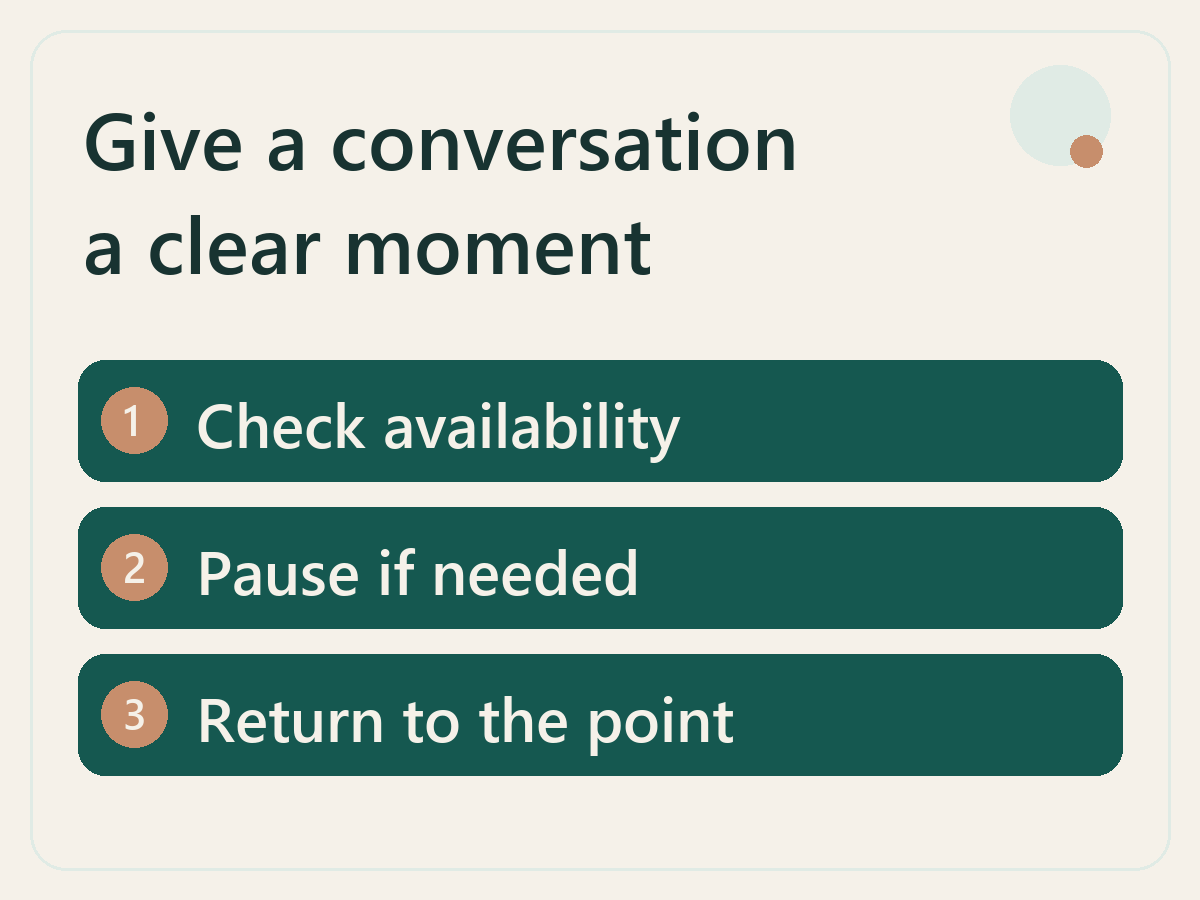
Begin by checking whether the moment is available for a real conversation. Then agree on how either of you will handle an interruption and return to what was being said. You can ask for attention without demanding access to the device or treating every notification as evidence of indifference.
Name the interruption you can actually describe
“When you opened your phone while I was explaining this, I lost my place” describes an event. “You care more about your phone than me” makes a claim about motives. You do not need the second claim to explain why the first event bothered you.
A phone might be serving an urgent responsibility, an accessibility need, a habit, or an ordinary distraction. Ask what is happening instead of deciding from a glance. An explanation can help you make a practical plan; it does not mean you must continue an important conversation with only part of someone’s attention.
A 2016 study by McDaniel and Coyne surveyed 143 married or cohabiting women. More perceived technology interruptions were associated with more reported technology-related conflict and lower relationship satisfaction. The questionnaire cannot establish that a phone caused the conflict or explain one person’s intent. Read the authors’ repository record on technology interruptions in relationships.
Ask whether now is a workable time
Before opening something important, try: “Is now a time you can focus with me for a few minutes, or should we choose another time?” This gives both people a way to be honest about their availability.
If your partner is waiting for an essential update, you can decide whether to pause, share the short version, or talk after it arrives. A clear alternative is more useful than “Later” with no return point. For example: “Let’s talk after you finish that call and before we start the film.”
You can use the same approach when you are the person whose attention is divided. Saying “I want to hear this, but I cannot follow it properly right now” gives your partner information that silent scrolling does not.
Agree on an interruption and a return
Keep the agreement mutual and realistic. The person who needs to check something can say so, pause the conversation, and signal when they are ready to return. The speaker can stop instead of competing with the screen.
A simple version is: “If either of us needs the phone, let’s say that we are pausing. When we come back, we can pick up the last point.” These are optional original suggestions, not a research-tested protocol or a demand for perfect attention.
Decide what deserves an interruption in your circumstances. Caregiving, accessibility tools, safety alerts, and time-sensitive responsibilities may need flexibility. You do not have to agree that every notification is urgent, and you do not need a universal list that fits every couple.
After checking, the listener might say: “I’m ready now. You were telling me what happened after the plans changed.” That small return shows where attention is going and gives the speaker a place to continue.

Try it in an ordinary moment first
In this fictional example, Leah wants to explain a change to a weekend visit. Devon is watching for a message from someone they are meeting. He says, “I need to answer when it arrives so they know where to go. Shall we sort that out first, then talk about the visit?” They handle the time-sensitive message and put the conversation back in the foreground.
On another evening, a non-urgent notification interrupts Leah’s story. She says, “I lost my place when the phone came out. Is there something we need to pause for?” Devon recognizes the habit, puts the phone aside, and asks her to continue. Leah does not inspect the notification; the repair is about attention.
A short, low-stakes conversation can help you discover what works before trying the agreement during a difficult discussion. Sitting somewhere else, silencing optional notifications, or choosing a different time may help if both people want to try it. A phone used for communication or accessibility does not have to leave the room.
Protect the conversation without policing the device
If interruptions keep happening, you can set a boundary around your participation: “I want to finish this when we can both follow it. I’m going to pause, and we can choose a better time.” Pair that with a concrete effort to return; pausing should not become a way to leave every concern unfinished.
Wanting attention does not entitle either person to passwords, private messages, location history, or control of the other person’s phone. Taking a device away, setting traps, or demanding proof of every alert creates a different problem.
If a reasonable request repeatedly brings ridicule, intimidation, retaliation, or fear, focus on support and safety. Love is respect discusses responding when boundaries are not respected.
For an ordinary interruption, start with a question both people can use: “Can we give this a few minutes of attention now, or choose a time when we can?”
Response
[…] Choose a ritual simple enough to fit your week: ten focused minutes after dinner, a short walk, a morning check-in, or a screen-free cup of coffee. Agree on a time and ask what each of you would enjoy. The Gottman Institute’s suggestions for connection rituals include undistracted meals, listening, and staying curious about each other. The ten-minute suggestion here is a practical starting point, not a tested minimum. If notifications keep interrupting that time, try asking for attention when your partner checks their phone. […]