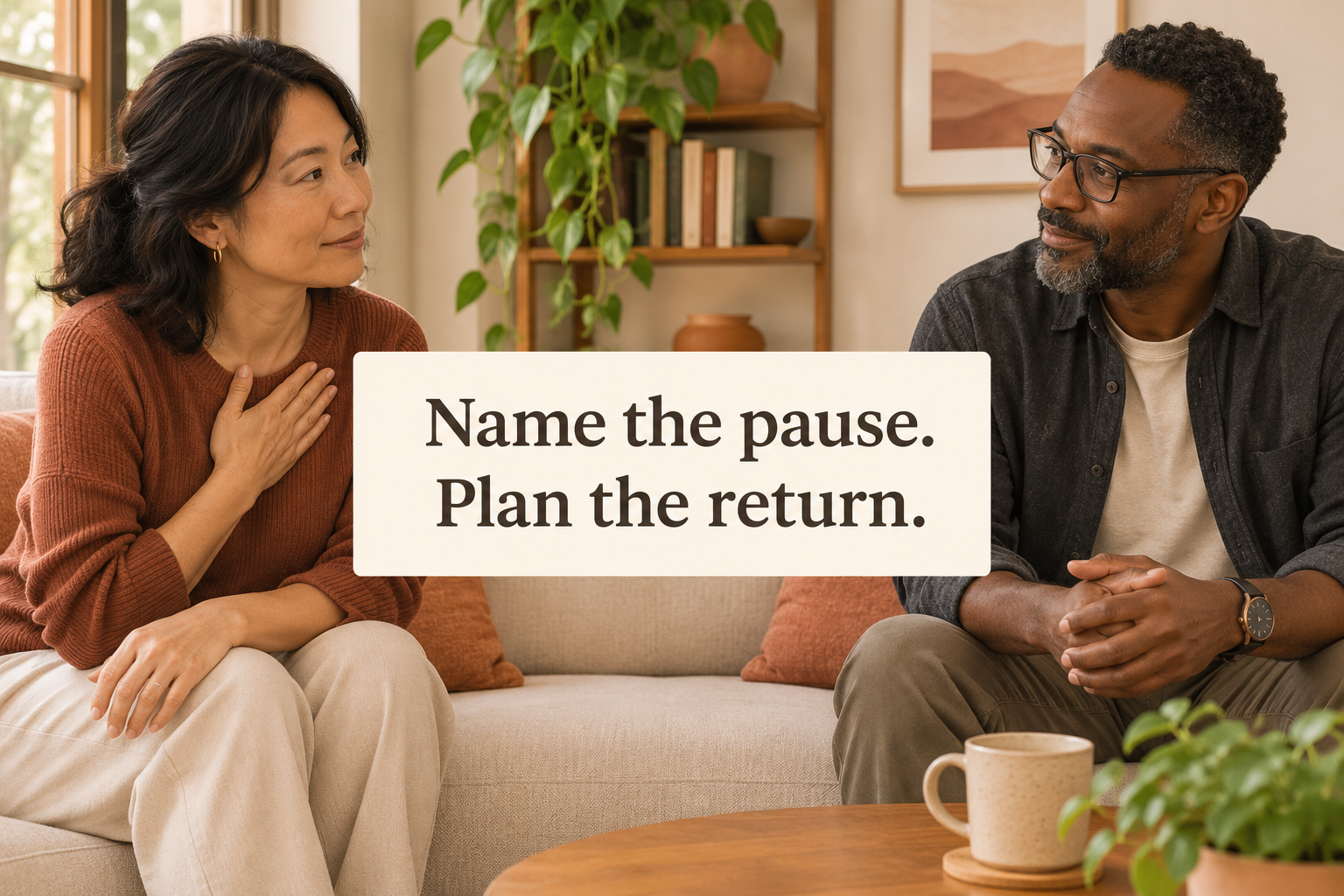
Explain your need for a pause and agree on a realistic return point.
To take a break during an argument and come back, say why you need to pause, make it clear that the conversation still matters, and name a realistic time to check in again. Use the break to settle, then return to one issue you can discuss. This approach is for disagreements where it is safe to continue the conversation.
You may want to keep talking until the problem is resolved, while he says he cannot think clearly anymore. Or you may be the one who needs space. A pause is easier to understand when the other person knows what it means and what happens next. Neither of you has to guess whether “later” means after dinner or never.
Name the pause before walking away
When possible, explain what is happening in a sentence you can actually say. “I’m getting too worked up to listen well” tells your partner about your present capacity. “You’re impossible” makes the pause another accusation. You do not have to settle who is right before admitting that the current exchange is going nowhere.
For example: “I want us to talk about this, and I’m not responding well right now. I need a break. Could we check in again at eight?” The time is illustrative; choose a realistic point in your own day. If you are leaving the room, a simple explanation can prevent the other person from having to interpret the movement alone.
If he asks for the break, you can acknowledge it and ask for a return point: “Okay. I can pause. When can we check in about this again?” Acknowledging his need for space does not mean you agree with his position or have decided the issue no longer matters.
Make the return realistic
The Gottman Institute’s guidance on taking a break and reconnecting recommends giving yourself time to settle and avoiding an indefinite timeout. It suggests at least twenty minutes. Treat that as guidance, not a stopwatch that proves either person should be ready or requires you to restart an unsafe conversation.
A return point can be a short check-in rather than a promise to solve everything at once. You might agree to meet after a walk, once a practical responsibility is finished, or at a particular time that evening. Name what you will do if the timing changes, too: send an update before the agreed time instead of leaving the other person waiting without information.
If one of you is leaving for work or needs sleep, be honest about that constraint. A promise you already know you cannot keep does not make the pause clearer. Offer a time you can reasonably honor and check whether it works for the other person.
Use the break to settle
Choose a quiet activity that helps you step away from the exchange: sit somewhere comfortable, take an ordinary walk if that is safe, or do a simple task. Notice whether you are resting or rehearsing a stronger argument. You can write down the one point you want to return to without building a case about everything your partner has ever done.
Give the agreed pause some space. Sending a series of messages from another room can continue the argument even though you are no longer face to face. An urgent practical message is different from restarting the dispute by text. You can agree on that distinction when you are both calm.

Come back to one issue
Begin by checking whether you are both ready for a short conversation. Then name the practical question. “Can we decide how to handle the booking?” gives the discussion a smaller starting point than “We need to fix everything.” Each person can explain what they understood and what they need next.
Try an opening such as: “I’ve had time to think. I was upset about the last-minute change. I’d like us to agree on how we let each other know.” If you spoke harshly before the pause, acknowledge that specifically without adding a condition: “I’m sorry I called you selfish. I want to explain the actual problem more clearly.”
A return conversation also needs attention. If screens keep interrupting, you can use the separate approach in asking your partner for a phone-free moment to agree on a workable setting. You are asking for a chance to talk, not access to private messages.
If the return does not happen
If you are still too unsettled at the agreed time, say so and propose a specific alternative. “I’m not ready to do this well yet. Could we talk after breakfast?” is information your partner can respond to. It does not mean they must be happy with the delay or agree that the issue can wait indefinitely.
Repeated missed returns deserve a separate conversation when you are calm: “We keep pausing this and then never coming back. Are you willing to choose a time to address it?” Listen to the answer and look at follow-through. You cannot make a joint discussion happen by finding a perfect timeout phrase on your own.
Love is respect’s guidance on respectful conflict emphasizes that disagreement does not remove your right to respectful treatment. Insults, intimidation or threats are not something you must accept to prove you are willing to communicate. If you feel unsafe, prioritize getting support you can access safely; a planned return to the argument is not an obligation.
Agree on a pause while things are calm
Before the next difficult conversation, choose a simple pause phrase and a way to set a return time. You might ask: “If either of us needs a break, can we say that clearly and agree when to check back in?” The useful part is the shared understanding and follow-through, not having the most polished wording.
Leave a Reply